


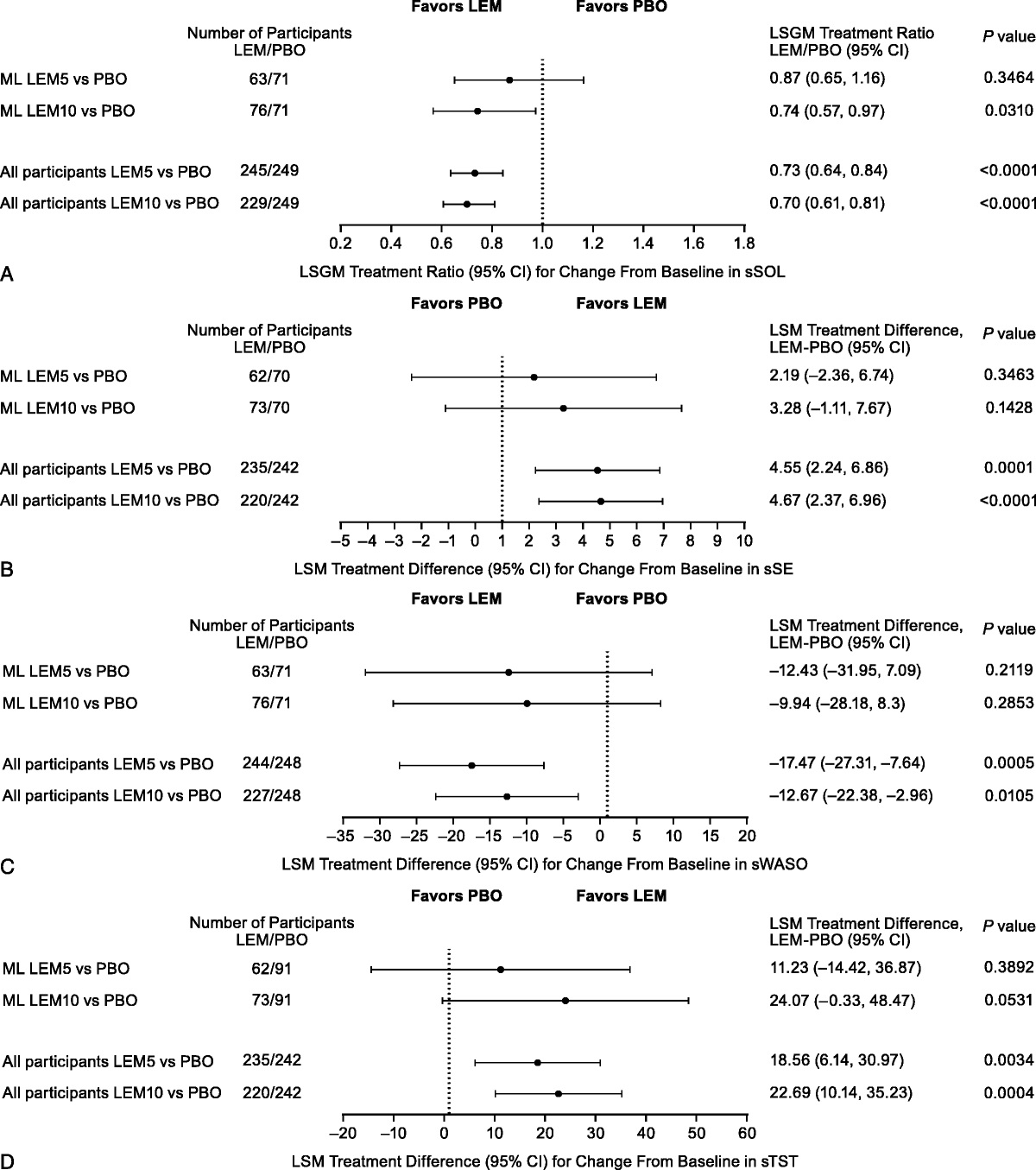
Efficacy and safety of lemborexant in midlife women with... : Menopause
zed, double-blind, placebo (PBO)-controlled (first 6 mo) study of adults with insomnia disorder (N = 949). During treatment period 1 (TP1), participants received PBO or LEM 5 mg (LEM5) or...
Conclusions: Consistent with the total population, subjective sleep parameters improved, and improvement was sustained over time in midlife women. LEM was well tolerated, suggesting that LEM may be a potential treatment option for midlife women with insomnia.
Meaningful Within-Patient Change on the Insomnia Daytime Symptoms and Impacts Questionnaire (IDSIQ): Analysis of Phase III Clinical Trial Data of Daridorexant - Pharmaceutical Medicine
Source : https://link.springer.com/article/10.1007/s40290-023-00484-w
Background The Insomnia Daytime Symptoms and Impacts Questionnaire (IDSIQ) is a new validated 14-item patient-reported outcome (PRO) instrument for evaluating daytime functioning in people with insomnia. It comprises three domains:...
Conclusion: This analysis demonstrates the meaningful within-patient change for the IDSIQ total score and domain scores, that the instrument is sensitive to changes in the patient experience of insomnia, and that it can be used in clinical trials to evaluate changes in daytime functioning.
Treating depression with a smartphone-delivered self-help cognitive behavioral therapy for insomnia: a parallel-group randomized controlled trial | Psychological Medicine | Cambridge Core
Treating depression with a smartphone-delivered self-help cognitive behavioral therapy for insomnia: a parallel-group randomized controlled trial - Volume 53 Issue 5
Relevance: This study evaluated a self-help smartphone-based CBT-I in alleviating major depression and insomnia.
Rest-activity rhythms predict time to hospitalizations and emergency department visits among participants in a randomized control of adults with heart failure and insomnia
Source : https://www.sciencedirect.com/science/article/abs/pii/S1389945723001880?via=ihub
We examined the effects of insomnia and diurnal rest-activity rhythms (RARs) on time to hospitalizations and emergency department (ED) visits in a ran...
Conclusions: Insomnia severity and RARs independently predicted hospitalizations and ED visits independent of clinical and demographic variables. Further research is necessary to determine whether improving insomnia and strengthening RARs improves outcomes among people with HF.
Insomnia among community members in Florida: Associations with demographics, health conditions, and social support | Journal of Clinical and Translational Science | Cambridge Core
Insomnia among community members in Florida: Associations with demographics, health conditions, and social support - Volume 7 Issue 1
Conclusions: This study provides evidence regarding who is at greater risk for insomnia among a large community-based sample. Our findings highlight the importance of screening for insomnia, particularly among patients who experience food insecurity, are military veterans, have anxiety, depression, ADHD, or cardiometabolic disease, as well as...