


Genetic evidence for a potential causal relationship between insomnia symptoms and suicidal behavior: a Mendelian randomization study - Neuropsychopharmacology
Source : https://www.nature.com/articles/s41386-022-01319-z
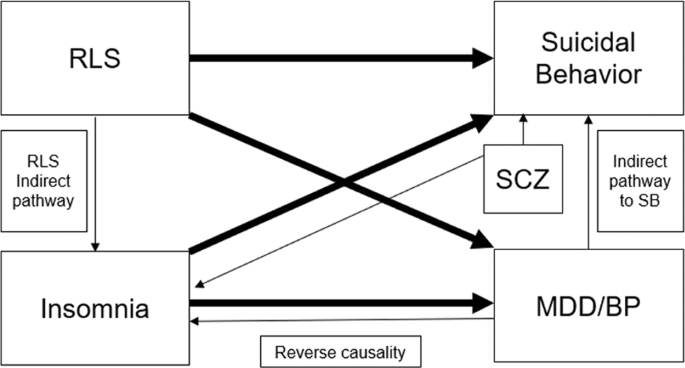
Insomnia and restless leg syndrome (RLS) are associated with increased risk for suicidal behavior (SB), which is often comorbid with mood or thought disorders; however, it is unclear whether these relationships are causal. We performed a two-sample Mendelian randomization study using summary-level genetic associations with insomnia symptoms and RLS against the outcomes of risk of major depressive disorder (MDD), bipolar disorder (BP), schizophrenia (SCZ), and SB.
Conclusion: Human genetic evidence supports for the first time a potentially independent and causal effect of insomnia on SB and encourages further clinical investigation of treatment of insomnia for prevention or treatment of SB.
• Source: Neuropsychopharmacology
• Conclusion: “Human genetic evidence supports for the first time a potentially independent and causal effect of insomnia on SB [suicidal behavior] and encourages further clinical investigation of treatment of insomnia for prevention or treatment of SB.”
• Harvard medical school researchers used Mendelian randomization to analyze whether genetically proxied insomnia symptoms and restless-leg syndrome (RLS) mediate suicidal behavior. They also examine relationships with mood and thought disorders.
• Although they found that insomnia is a risk factor for major depressive disorder and bipolar disorder, genetically proxied RLS was not related to psychiatric illness. In other words, insomnia’s link to psychiatric illness is independent of RLS.
• As for a mechanism, the authors suggested the “stress accumulation” hypothesis, which posits that insomnia is linked to the insufficient dissolution of emotional distress secondary to REM sleep dysfunction and fragmentation, which could result in emotional distress accumulation.
• “Our finding that insomnia is a causal risk factor for MDD and SB further supports the treatment of insomnia in patients with MDD and SB,” the authors wrote. “Treatment of insomnia and depression can be done concomitantly or sequentially. Our finding of a bidirectional effect (since reverse MR showed MDD increased the risk for insomnia symptoms) supports a concurrent treatment approach for both disorders. Our results also support the investigation of treatment of insomnia for the prevention of SB.”
• One limitation of the current study is that the sample may be too healthy, without the same comorbidity burden as the general population. Another limitation was the subjective nature of psychiatric biomarkers.