


Disease Spotlight
Agitation in Alzheimer's Dementia
Profile Image
  • Saved
case study

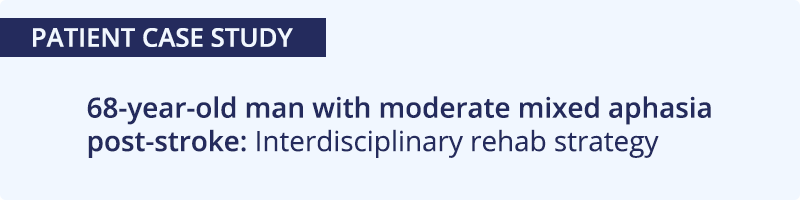
Patient Background: A 68-year-old married man with vocational education, living in a city, experienced his first ischemic stroke. Six months later, he was diagnosed with moderate mixed aphasia. This condition often lowers quality of life across physical, psychological, and environmental domains.

Family History: No specific hereditary link to stroke or aphasia was reported. However, his marital status aligns with evidence that family support can aid stroke recovery and improve well-being.

Assessment and Diagnosis: Stroke was diagnosed via brain imaging (CT/MRI). A speech-language pathologist confirmed moderate mixed aphasia using the SODA scale and Jadwiga Szumska’s Aphasia Test Method.

Suggested Treatment Plan: A multidisciplinary plan, including individualized speech-language therapy, is essential. Interventions tailored to his needs aim to improve communication and overall functioning in moderate aphasia.

Patient education: Aphasia impairs communication, reading, writing, and numeracy. Patients and caregivers were educated on consistent therapy, coping strategies, and the importance of social interaction in recovery.

Follow-up: The WHOQOL-BREF tool at six months post-discharge helped monitor progress. Ongoing reassessment remains vital to adjust therapy and enhance outcomes.

  1. How can interdisciplinary teams support recovery in moderate aphasia post-stroke? Answer Team-based care with early speech therapy, counseling, occupational therapy, and social work improves communication and quality of life.
  2. Why is early, tailored speech therapy key for moderate mixed aphasia? Answer Early diagnosis and individualized SODA-guided therapy improve function and help maintain quality of life.
  • Saved
case study

Patient Background: Mrs. Green, a 72-year-old woman, presented to her GP with concerns about progressive memory decline. She was undergoing evaluation as part of routine cognitive screening for older adults.

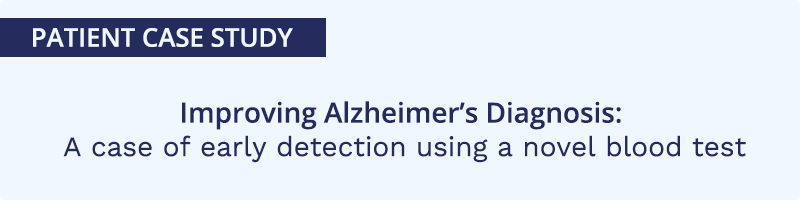
Assessment and Diagnosis: Initial clinical evaluation through physical and cognitive assessments in primary care has shown only 61% diagnostic accuracy for Alzheimer’s disease. A blood test (PrecivityAD2) measuring p-tau217 was used, predicting Alzheimer’s with 88–92% accuracy. CSF and PET scans, while highly accurate, are less accessible in primary care.

Suggested Treatment Plan: Following a positive test result, FDA-approved anti-amyloid therapy was initiated to help slow disease progression.

  1. How could blood-based biomarker tests reshape Alzheimer’s diagnosis in primary care? Answer Blood-based biomarkers enhance early detection, reduce reliance on specialty imaging, and improve access to timely treatment.
  2. Beyond being less invasive, what role does the Lumipulse plasma ratio test play in Alzheimer’s diagnosis? Answer It helps identify amyloid plaques in adults 55+ with cognitive symptoms, aiding diagnosis in specialized care. Not for screening—results must be interpreted with clinical findings.
  • Saved
Exploring the Therapeutic Impact of Repetitive Transcranial Magnetic Stimulation (rTMS) in Individuals With Alzheimer's Disease: A Comprehensive Narrative Review - PubMed

Exploring the Therapeutic Impact of Repetitive Transcranial Magnetic Stimulation (rTMS) in Individuals With Alzheimer's Disease: A Comprehensive Narrative Review - PubMed

Source : https://pubmed.ncbi.nlm.nih.gov/40575244/

Alzheimer's disease (AD) is a progressive neurodegenerative disorder marked by cognitive deterioration and behavioral symptoms, significantly impacting patients and caregivers. Behavioral and psychological symptoms of dementia (BPSD), including agitation, depression,...

This narrative review explores rTMS as a non-invasive treatment for Alzheimer's disease, highlighting its potential to improve cognitive function and reduce agitation, depression, and other neuropsychiatric symptoms.

  • Saved
  • Saved

Did you know? The American Psychiatric Association recommends structured psychotherapy—like Dialectical Behavior Therapy and Mentalization-Based Treatment—as the gold standard for Borderline Personality Disorder, with medication used only for specific symptoms and always alongside therapy. Person-centered plans and collaboration are key.

Did you know that clinicians are encouraged to use standardized symptom scales at the start of BPD treatment to track progress over time?

 NCCN Guidelines

Did you know that clinicians are encouraged to use standardized symptom scales at the start of BPD treatment to track progress over time?